File format
Problem — .ipps
Four sections.
1. Header
2. Graph (out)
Starts with a literal out line. Each subsequent line declares the outgoing edges of one operation:
means the edges u → v1, u → v2, … . An OR-connector is written by wrapping the OR-set in parentheses with no spaces:
means operation 1 has an OR fork — exactly one of {15, 11, 13} will eventually be picked.
3. Join (in)
Starts with a literal in line. Each line names the operations that join into one downstream operation:
means operations 2 and 3 are the tails of two OR branches that join at operation 4.
4. Processing time (info)
Starts with a literal info line. Three kinds of rows:
<op_id> start— the job's super-start node (no processing).<op_id> end— the job's super-end node (no processing).<op_id> supernode— an internal OR helper node (no processing).<op_id> <n> <m_1> <t_1> <m_2> <t_2> ...— operationop_idcan be processed onnmachines; machinem_itakes timet_i.
Minimal example
A 1-job / 2-machine illustration:
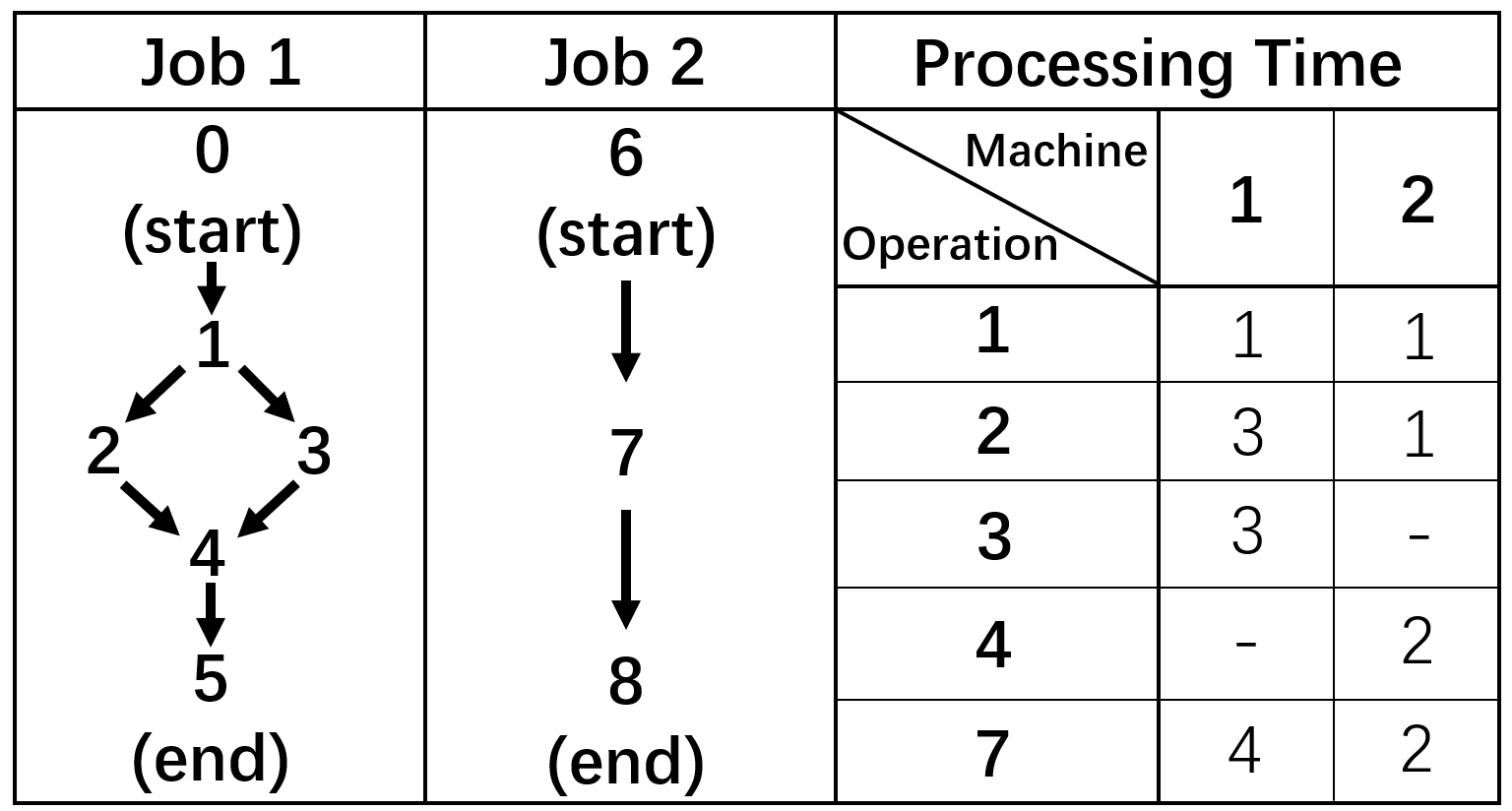
The full bundled example lives at data/example/problem.ipps and is rendered below:
Solution — .ippssol
<total_makespan>
<op_id> <ma_id> <job_id> <start_time> <end_time>
<op_id> <ma_id> <job_id> <start_time> <end_time>
...
First line is the total makespan; every subsequent line is one scheduled operation.